
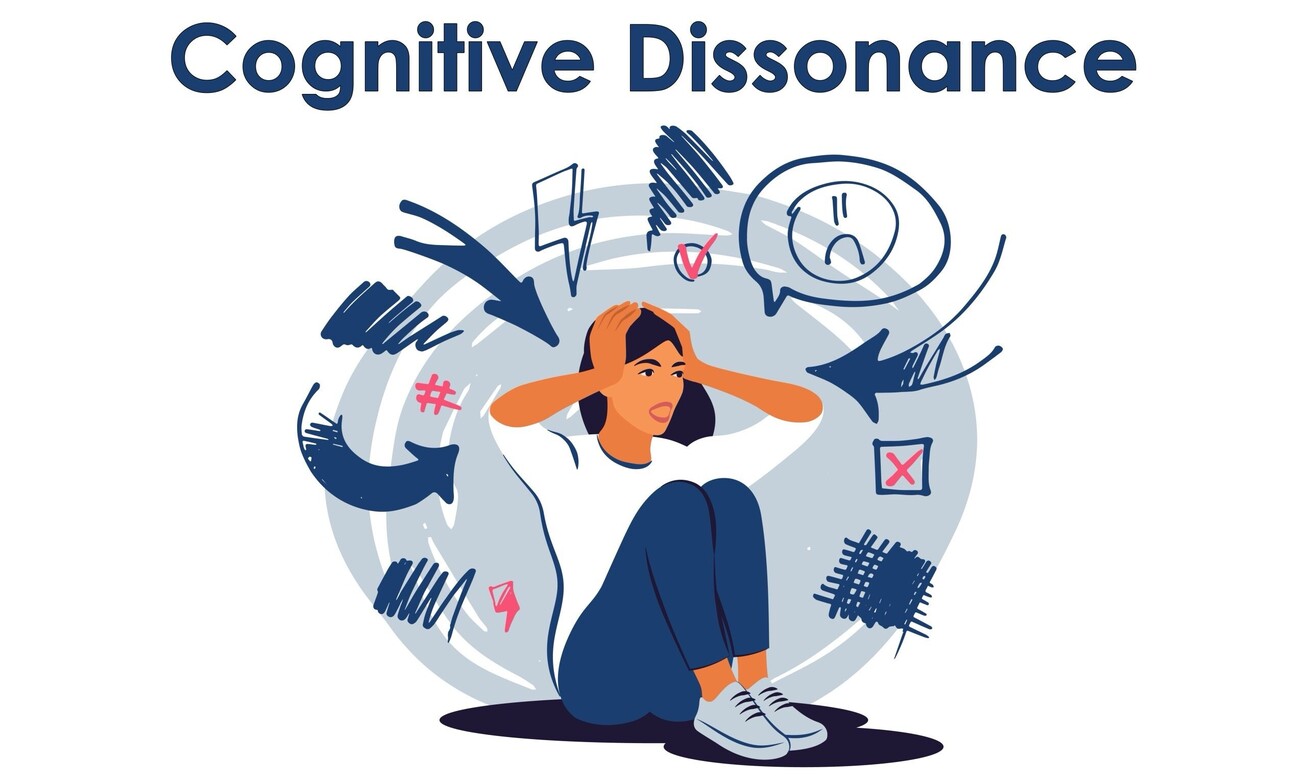
Have you ever known deep down that something was wrong in your relationship, but felt completely unable to act on it?
Have you found yourself defending someone who hurts you, doubting your own memory, or feeling paralyzed between two completely opposite truths at the same time?
You are not weak. You are not crazy. You may be experiencing Traumatic Cognitive Dissonance.
What Is Traumatic Cognitive Dissonance?
Cognitive dissonance, a term first introduced by social psychologist Leon Festinger in the 1950s, describes the psychological discomfort of holding two contradictory beliefs at the same time (Festinger, 1957). In the context of prolonged psychological abuse, this becomes something far more serious.
Traumatic Cognitive Dissonance (TCD) is a state of internal collapse and psychological paralysis caused by chronic exposure to manipulation, gaslighting, coercive control, and reality distortion by a disordered partner. It is not simply confusion or indecision. It is a trauma response that affects the brain, the nervous system, and the core sense of self.
What Is Happening in Your Brain?
Research in neuroscience and trauma psychology explains why TCD is so disabling. When a person is repeatedly subjected to contradictory messages, “I love you” and “you are worthless”, the brain enters a state of neural conflict. Regions of the brain responsible for detecting contradictions become hyperactive, producing chronic anxiety, confusion, and a persistent “stuck” feeling.
Rather than triggering a full fight-or-flight response, the nervous system moves into freeze mode, a state of psychological and physiological immobilization that makes it nearly impossible to think clearly, set boundaries, or make decisions. This is reinforced neurochemically through dopamine fluctuations, cortisol dysregulation, and oxytocin release during brief moments of warmth or reconciliation, what survivors often describe as “breadcrumbs of affection.” This is the neurological foundation of what is known as a trauma bond.
Peer-reviewed research confirms that cognitive dissonance is a core mechanism that keeps survivors trapped in abusive relationships and is one of the greatest obstacles to leaving.
Signs You May Be Experiencing Traumatic Cognitive Dissonance
- Racing, preoccupied thoughts about the relationship that you cannot switch off
- Feeling emotionally frozen, paralyzed, or detached from yourself
- Chronic indecision and an inability to trust your own judgment
- Doubting your memory of events, even events you clearly remember
- Compulsive self-blame and apologizing for someone else’s behaviour
- Replaying arguments over and over, trying to “figure it out”
- Feeling both on high alert and completely shut down at the same time
- Confusion about how you truly feel about the person who is hurting you
- Feeling guilty for leaving, or guilty for staying
- Loss of identity; feeling like a shell of the person you used to be
- Intrusive thoughts, vivid nightmares, or psychosomatic symptoms (insomnia, fatigue, physical pain)
- Knowing something is deeply wrong but being unable to name it or act on it
TCD Is Not a Character Flaw. It Is a Survival Adaptation.
Traumatic Cognitive Dissonance is not a sign of weakness, stupidity, or lack of self-respect. It is a predictable neurological and psychological response to prolonged, intentional manipulation by someone skilled at exploiting human attachment systems.
Recovery from TCD goes beyond simply leaving the relationship. It requires:
- Validating your own experience and perceptions
- Rewiring your nervous system’s threat detection responses
- Trauma-informed therapy to rebuild trust in your own reality
- Reconnecting with your identity, values, and sense of self
Your confusion is not a weakness. It is evidence of what was done to you.
At Heartberry Counselling, we understand the unique and disorienting nature of Traumatic Cognitive Dissonance.
We offer a safe, compassionate, trauma-informed space to help you find your way back to yourself.
226-455-4765
heartberrycounselling@gmail.com
heartberrycounselling.com
This post is for educational purposes only and does not constitute medical, psychological, or legal advice.
All claims are drawn from peer-reviewed research and clinical sources.
References:
Festinger, L. (1957). A theory of cognitive dissonance. Stanford University Press.Porges, S. W. (2011). The polyvagal theory: Neurophysiological foundations of emotions, attachment, communication, and self-regulation. W. W. Norton & Company.
Salerno, P. (2025). Traumatic cognitive dissonance: Healing from an abusive relationship with a disordered personality. https://www.drpetersalerno.com/
Sapolsky, R. M. (2004).Why zebras don’t get ulcers: The acclaimed guide to stress, stress-related diseases, and coping (3rd ed.). Holt Paperbacks.
Vanbuskirk, S., & Levine, D. S. (2010). The importance of cognitive dissonance in understanding and treating victims of intimate partner violence. Journal of Aggression, Maltreatment & Trauma, 19(7), 780–797. https://bearworks.missouristate.edu/articles-chhs/595/
Zafar, S., & Anand, T. (2025). Patriarchal roots of cognitive dissonance and the impact on intimate partner violence. Journal of Interpersonal Violence. https://journals.sagepub.com/doi/10.1177/08862605251355624

Kim L McCullough
Contact Me